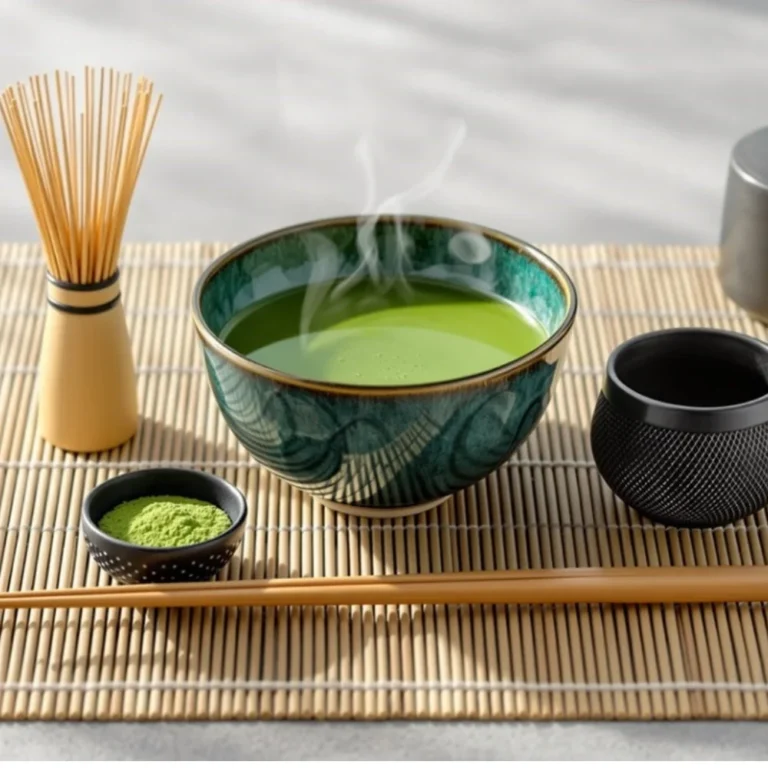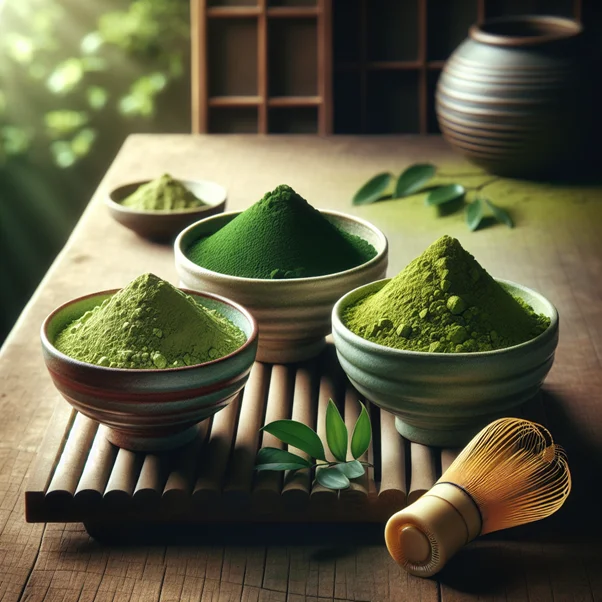

There is not much to making a good bowl of matcha, but the small things matter. Get the amount, the water temperature and the whisking right and you get a smooth, gently sweet cup with a fine jade froth. Get them wrong and it turns bitter, thin or lumpy. This guide walks through all three, with a couple of tools to take the guesswork out.
Start with the ratio
Most bad matcha is simply the wrong strength. Too little powder and it tastes of warm water, too much and it turns sharp. A traditional bowl sits at around two grams of matcha, a little over half a teaspoon, to sixty millilitres of water. Set the calculator below to what you are making and how strong you like it, and it gives you the exact matcha, water and milk to use.
How much matcha?
Get the ratio right for whatever you are making.
Mind the water temperature
This is the step people skip, and it is the one that matters most. Boiling water scorches matcha and drags out its bitterness. You want it just off the boil, around 80 degrees. If you do not have a temperature-controlled kettle, boil it and let it stand for two minutes, or add a splash of cold water to the bowl first. That single change fixes more bitter cups than anything else.
The method, step by step
Measures sorted and water cooled? Here is the method, one step at a time. Work through it with the guide below, and use the built-in timer on the whisking step so you know when to stop.
Whisk the perfect bowl
Four steps, about two minutes.
Sift
Sift 1 to 2 teaspoons of matcha into your bowl. It stops the lumps before they start.
Add water
Pour in about 60ml of water just off the boil, around 80C. Boiling water scorches matcha and turns it bitter.
Whisk
Whisk briskly in a light W or M motion, not round in circles, for 15 to 20 seconds until a fine jade froth forms on top.
Enjoy
Drink it straight away while the froth holds, or pour it over steamed milk for a latte.
Why the W motion matters
Whisking in circles looks natural but does very little. It drags the powder round without pushing air in, so you get a flat, foamless cup. The quick W or M shape across the base of the bowl is what breaks the surface and folds air through, and that is where the fine froth comes from. Keep your wrist loose and let the whisk do the work rather than pressing it into the bottom of the bowl. Twenty seconds of proper whisking beats a minute of half-hearted stirring.
Fixing the three common problems
My matcha is bitter
Almost always the water was too hot. Let the kettle stand a couple of minutes after boiling so it drops to around 80 degrees. A very strong ratio or a lower-grade, older powder can also read as bitter, so ease off the amount and keep your tin sealed and cool.
It is full of lumps
Matcha clumps as it sits, so sift it into the bowl before the water goes in. Once it is lumpy in water it is hard to rescue. Sifting takes ten seconds and stops the problem at the source.
I get no froth
Two usual causes: whisking in circles instead of a brisk W, or not enough powder. Use the ratio from the calculator, keep the whisk moving quickly across the surface, and give it a full twenty seconds. A good bamboo whisk with plenty of fine tines makes a real difference here.
What you need to start
All you really need to begin is our Grade A ceremonial matcha, a bamboo whisk and a wide ceramic bowl. A bamboo spoon for measuring and a sifter help, but they are refinements. If you would rather pick it all up in one go, the matcha starter kit pairs the three essentials at a better price than buying them apart, and the find your matcha quiz will point you to the right grade first.
Once you have the bowl right, put it to use. The matcha latte and the iced version both start from this same whisked base.